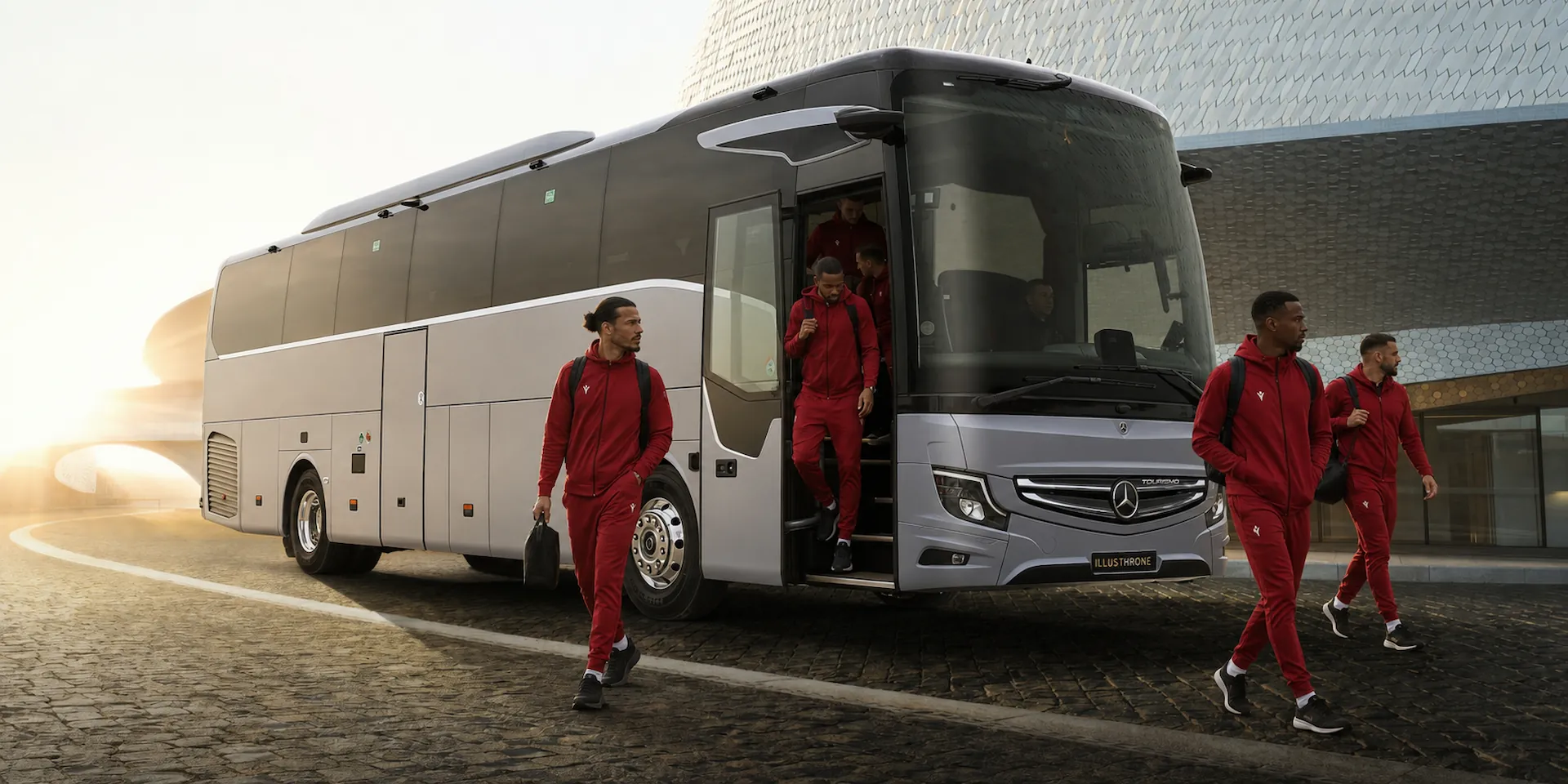
When a professional team travels, the visible requirement is usually described in simple terms: flights, hotel rooms, a team coach and transfers to training and competition venues. Those elements matter, but they do not describe the operation.
A team is not one passenger group. It is a performance environment moving between airports, hotels, training facilities and venues under fixed deadlines. Players, coaching staff, medical teams, club executives, federation officials, operational personnel, media, equipment and sometimes supporter groups may share the same destination while requiring different plans.
Over the years, members of the Illusthrone team have contributed to travel, hospitality and operational assignments involving Stoke City, Werder Bremen, Napoli and Shakhtar Donetsk, as well as Istanbul Cup international tennis tournaments. The names are relevant, but the more useful lesson lies in what these environments repeatedly demonstrate: transportation is only one layer. The real task is to protect focus, timing and continuity around the people who are there to compete.
Performance begins before the team arrives
The quality of a sports operation is often decided long before the aircraft lands. The first brief must go beyond passenger numbers and arrival times. It should identify who is travelling, how the group is divided, what equipment is moving with them, which decisions are fixed and which may still change.
Rooming lists, guest lists, dietary requirements, allergies, security and close-protection needs, training plans, special visits, media responsibilities, supporter programmes and requests outside the competition schedule all affect the operational structure. A missing detail rarely remains isolated. It can change vehicle capacity, hotel space, staffing, access permissions or the timing of an entire movement.
Illusthrone may contract directly with a club or federation, with an authorised team travel agency or through another responsible representative. The contractual route can vary. Operationally, however, our preference is clear: one central command structure, one accountable view of the programme and one team capable of seeing how every decision affects the rest.
One command structure does not mean one conversation
Professional sport involves many responsible parties. The club travel or operations manager remains a central counterpart. Hotels, transport teams, airports, training facilities, venues, security units, authorities, caterers and other third parties each control part of the operation.
The solution is not to remove those specialists. It is to prevent them from operating as disconnected islands.
Illusthrone maintains continuous communication with the authorised club or federation representative while coordinating third parties under one operational structure. Information is checked across workstreams, changes are distributed to those who need them and the operation is monitored around the clock. This reduces the risk of a decision being correct within one department but disruptive to the programme as a whole.
A team should never be responsible for holding its own travel operation together while preparing to compete.
A team coach is not simply a large vehicle
The team coach must be recent, dependable and appropriate for the level of the programme. The driver must be experienced, presentable and capable of following a disciplined schedule under pressure. Capacity must reflect the real passenger and baggage profile rather than a generic seat count.
Team branding, Wi-Fi, beverages, food service and other onboard requirements can then be arranged around the club’s preferences. Depending on the scale of the movement, the coach may be supported by a baggage vehicle, technical-team minivan, executive cars, security vehicles, a backup coach or driver and, where authorised by the competent authorities, a police escort.
These vehicles are not optional decorations around the main coach. They create separate but coordinated movement streams, allowing equipment, executives, staff and players to reach the same operational objective without unnecessary congestion.
Istanbul rewards preparation and punishes assumptions
Türkiye is Illusthrone’s principal destination for sports operations, and Istanbul is the most important hub within it. That local focus is an advantage only when it is supported by realistic planning.
Istanbul can involve three airports, highly variable traffic, event-related road restrictions, venue-specific access, large supporter movements and changing security conditions. A route that appears simple on a map can create a very different result at a particular hour on match day.
Istanbul Airport, Sabiha Gökçen Airport and Istanbul Atatürk Airport can all serve team-related travel depending on the flight and mission. When private aviation and current operating conditions allow, Atatürk Airport’s General Aviation Terminal often provides a particularly compact and operationally convenient environment. The right answer still depends on the aircraft, permissions, team destination and wider schedule.
Local knowledge does not replace inspection. Routes, vehicle positions, loading areas, training facilities, stadium entrances, parking points and security processes must be checked for the specific operation. Familiarity provides speed; inspection protects against complacency.
The hotel becomes part of the performance environment
A team hotel is not selected only for its category or room count. Access, privacy, noise, internal circulation, food-and-beverage flexibility, meeting space and proximity to training and competition venues can matter just as much.
Illusthrone may recommend, arrange and reserve the hotel, or coordinate a property selected by the team. Wherever possible, rooms are positioned in quiet areas that support privacy. Direct or convenient access to gym and spa facilities is considered. Private dining areas, meeting rooms, video-analysis space, medical or physiotherapy rooms, equipment storage and other team requirements are arranged according to the programme.
Food service should be close enough to the team rooms to protect time and reduce unnecessary public movement. Private halls can be used where available. Entry and exit routes, lift use and discreet access points are reviewed to limit exposure and preserve focus.
Food is logistics, culture and performance at the same time
Athlete meals are normally defined by the club, its chef and dietitian. Illusthrone’s role is to make those requirements operationally possible at the destination.
Allergy information and special dietary needs must be received accurately. Teams may require particular ingredients that are unfamiliar or difficult to source locally. Information about local food culture should be provided, while purchasing, specialist supply and the organisation of private chefs or assistant chefs are coordinated around the team’s instructions.
Food cannot be treated as a standard hotel banquet request. Preparation space, ingredient acceptance, kitchen access, serving hours and the team’s own culinary personnel may all require prior agreement.
Movement must be inspected, not estimated
Hotel-to-training and hotel-to-venue movements are tested against real conditions. The operational plan must account for vehicle loading, security checks, accreditation points, coach entrances, authorised parking, road restrictions and the time required to move the whole group—not simply the theoretical driving time.
Police escort, road controls and parking arrangements are coordinated with the relevant authorities when required and available. Illusthrone remains in contact with the responsible units and manages the movement within the permissions and instructions they provide.
The same attention applies after the match. Departure can involve a compressed schedule, additional security, equipment loading, changing passenger groups and a flight that cannot wait indefinitely. The return movement must be designed before the result, atmosphere and timing of the match are known.
The most common surprise is a request that did not exist yesterday
In our experience, the most frequent disruption is not an extraordinary external crisis. It is an immediate request outside the agreed programme or a last-minute change to a plan that was previously considered final.
Such requests may fall outside the original contractual scope, but the client still needs a practical answer. A commitment to client satisfaction means assessing the change quickly, understanding what it affects and implementing it as safely and smoothly as circumstances allow.
For larger operations, backup vehicles, drivers, routes and communication arrangements are prepared in advance. Contingency planning is not evidence that the main plan is weak. It is recognition that live sports operations change.
One difficult operation can contain several different crises
During one assignment, a visiting team was due to play in a socially conservative destination where accommodation options were extremely limited. The city’s only major hotel initially refused to provide rooms. The owner of the home club was also the owner of the hotel, adding another layer to an already sensitive situation.
We travelled directly to the destination and continued discussions face to face until accommodation for the visiting team was secured.
The next challenge appeared in the kitchen. The visiting team’s food culture and requirements were very different, and hotel kitchen personnel would not initially allow the requested ingredients into the main kitchen. After extended coordination, an alternative preparation area was created and the team’s required meals were produced within a dedicated dining structure.
Security and escort units sent by the authorities arrived without all the practical detail needed for the programme. They were briefed and their movement was coordinated through the operational plan. At the airport, the location provided no dependable mobile coverage, so radio equipment and a separate communication structure were organised.
Meanwhile, the authorised team travel representatives were experiencing the pressure of an unfamiliar and rapidly changing environment. Time was created for them to recover through carefully arranged visits to the region’s natural spa facilities and private meals at leading local restaurants.
None of these solutions belonged to one conventional service category. Hotel negotiation, food operations, security coordination, communications and hospitality had to be managed as one assignment. That is precisely why a single command structure matters.
Privacy and security are designed into the movement
Privacy cannot depend on asking people to be discreet after the team arrives. It must be built into vehicle, hotel, airport and venue procedures.
Hotel information is shared only where necessary. Vehicles can remain unbranded when the programme requires it. Drivers and operational personnel are instructed not to photograph or publish information about the team. Public and private entrances, controlled lifts, discreet loading areas and alternative access points are assessed wherever available.
Football usually requires the most extensive preparation because budgets, supporter density, public attention and the wider risk environment are often greater. Basketball programmes can also require sophisticated international coordination, particularly around EuroLeague, EuroCup and national-team fixtures. Volleyball and handball operations may work within more limited budgets, but still benefit from disciplined planning proportionate to the programme.
How early should planning begin?
For a comprehensive team or federation operation, beginning at least one month in advance is preferable. It allows time for inspection, hotel and venue coordination, vehicle configuration, security planning, special supplies and contingency arrangements.
Requests also arrive only days before travel. Illusthrone will still work intensively to coordinate the required services, but shorter lead times reduce the range of options and increase the importance of rapid, accurate decisions. The correct response is not to promise that timing has no consequence. It is to mobilise experience, identify what remains possible and protect the essential parts of the operation first.
The Illusthrone view
Club travel managers, operations directors, federation executives and specialist sports travel agencies do not need another supplier for each individual booking. They need a destination counterpart capable of understanding how the bookings affect performance, timing, privacy and institutional responsibility.
Illusthrone’s role is to create that continuity in Istanbul and across Türkiye: to coordinate the team, its representatives and every authorised third party through one disciplined operational structure.
The objective is not merely to move a team on time. It is to make sure travel never becomes the reason the team loses focus.